
 EN
EN



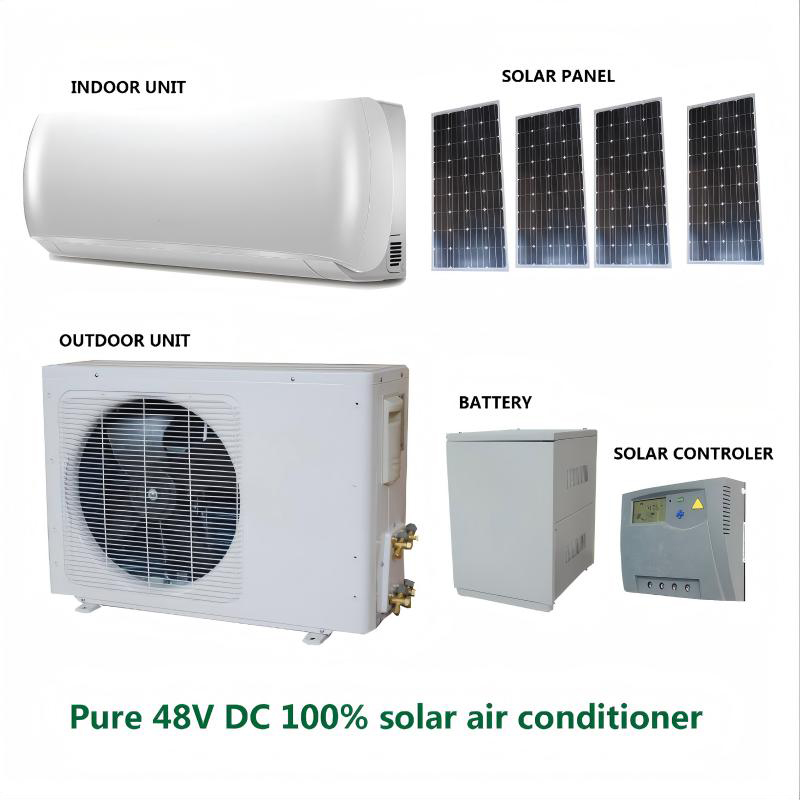
Demax Solar Air Conditioner Cooling Capacity Range: From Residential to Modular Commercial
Standard Residential Models: 9,000–24,000 BTU/h (0.75–2 Tons)
Demax solar-powered air conditioning units are available in sizes from 9,000 to 24,000 BTU per hour (approx. 0.75 to 2 Tons). They are ideal for cooling residential single rooms and stay considerably more efficient than conventional units, because they power themselves using built-in solar panels, reducing sudden demand to the utility grid. They can operate efficiently in rooms up to 1,200 square feet. Smaller units (9k to 12k BTU) are suitable for bedrooms, while larger units (24k BTU) are ideal for accommodating larger spaces such as living rooms. Remarkably, field tests show solar AC units are able to maintain approximately 85% of their cooling capacity at times of extreme solar intensity. This is achieved with no external battery storage. This is a unique quality and the reason solar ACs are better than conventional ACs which require power if the external storage battery is not available.
Commercial-Grade Units: 36,000–60,000 BTU/h (3–5 Tons) with Hybrid PV-Battery Support
Retail and office areas with cooling requirements in the range of 36,000 to 60,000 BTU per hour can use this 3 to 5 ton system employing an innovative design combining solar panels with lithium ion batteries. They can be operational for more than 18 hours per day just with the variation of sunlight of up to 30%, when the solar energy is not available on the cloud. It will use its stored energy to maintain the temperature of the space between 2,500 to 5,000 square feet. These solar energy batteries will minimize the peak demand charges due to the battery backup by more than 40% when compared to conventional grid connected systems.
Integrated Multi-System Technology: Up to 120,000 BTU/h (10 Tons) with Parallel Inverter Technology
Warehouse and factory owners can use parallel inverter technology to connect multiple 5-ton systems up to 120,000 BTU/h (10 tons) except with minimal ductwork running through the building. With this technology, the systems can be incrementally deployed throughout the site as the business or demand grows. These systems are equipped with intelligent control technology to ensure that the workload is evenly distributed among the inverters to prevent overloading. This will further reduce the operating cost of the system. Even when the ambient temperature is over 115°F, most models will still be able to provide at least 90% of their design cooling capacity. Research conducted at the NREL has shown that during extreme heat conditions, these units outperform the competing standard cooling rooftop units by 22%. These units are an excellent choice for cooling facilities in the warmer regions.
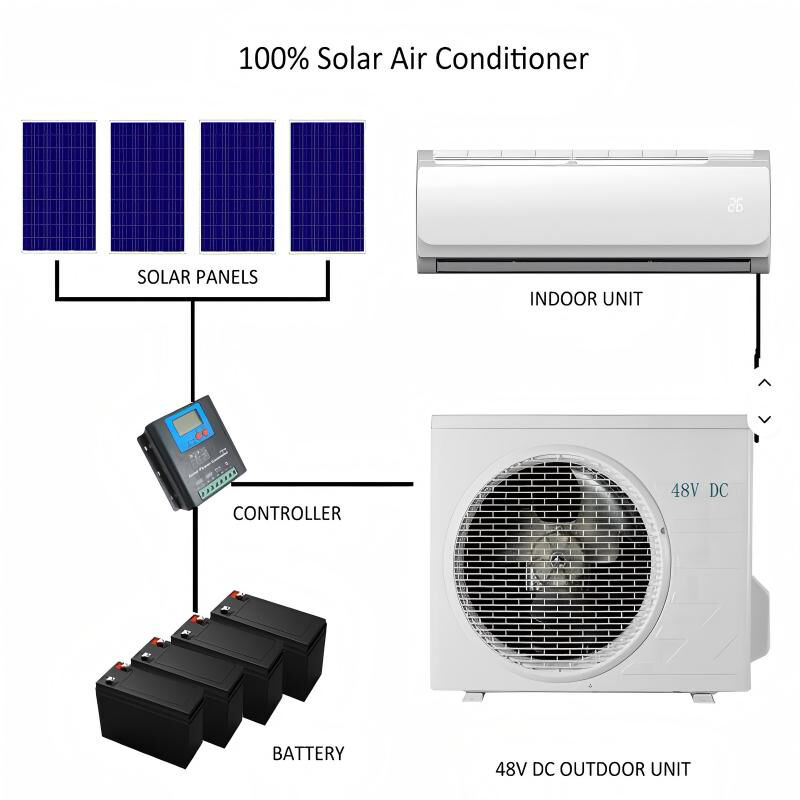
How to Size a Solar Air Conditioner for Real-World Load Conditions
Beyond Rule-of-Thumb: ASHRAE-Compliant Load Calculations for Off-Grid Solar Air Conditioner Sizing
The powered AC's solar challenges sizing that cannot be done with simple rules of thumb anymore. Heating and cooling engineers of ASHRAE have produced thorough analyses of how much heat is conducted through the walls, ceiling, and floors, how many people are in the space, and what technology they will be using. For off-grid systems, AC units experience energy usage jumps during extreme heat, enlarging the need to determine BTUs per hour. If an air conditioning unit is too small, it will have difficulty maintaining a cool temperature during increased external temperature spikes. However, an air conditioning unit that is too large will run the batteries down faster than expected, and will cause the components to age faster as well. Good solar HVAC professionals can be trusted to know this material as it comes from their training and experience. They understand the local weather patterns and, not merely the square footage of the space, and can stabilize the air temperature around comfortable levels (between :18 and :22 degrees Celsius) even when outside temperatures are as high as :45 degrees Celsius. When peak cooling demand does not occur during the same hours as the solar array generation, it is most likely the backup generator will be operating disproportionately to the peak demand hours. The outside air temperature is a significant variable in cooling and an air-conditioning unit’s maximum operational duration. Research studies have proven that in cases of mismatched demand and generation, the reliance on the backup generator may be increased by as much as 37%.
Impact of Roof Orientation, Local Insolation, and Battery Buffer on Delivered Cooling Capacity
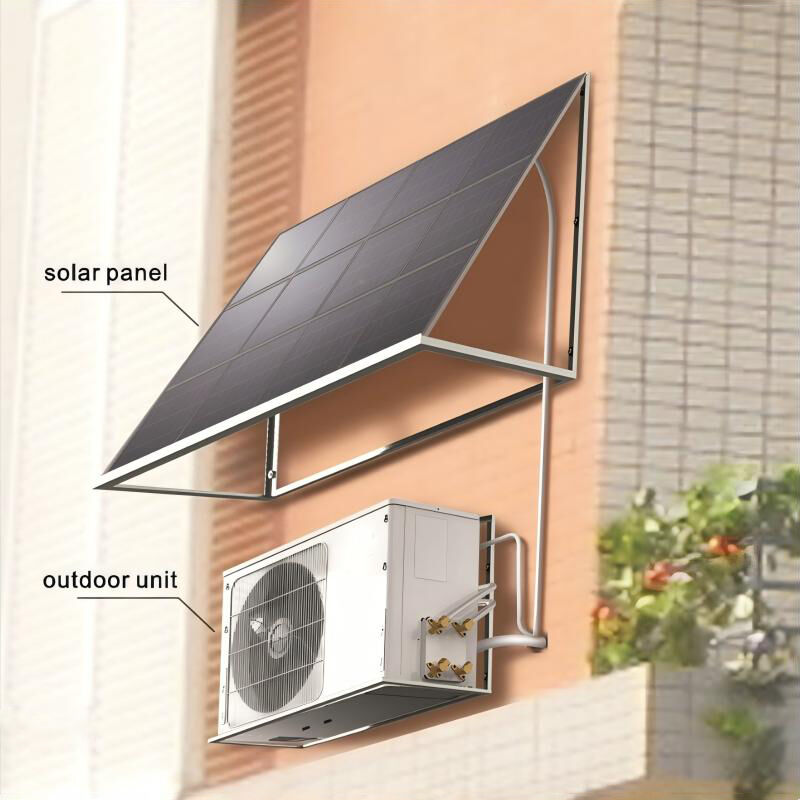
The environmental factors that influence the performance of a solar air conditioning system are one of the most determining factors. In most regions of the country, southern-facing roofs gather about 15 to 25 percent more sun than eastern or western-facing roofs. Local solar maps help illustrate this as well. For example, a system designer in Phoenix can use 30 percent fewer panels than the equivalent designer in Seattle, because Phoenix receives significantly more sun than Seattle. During overcast periods, batteries help maintain system performance and provide sufficient power to maintain cooling for two days. Shadows from neighboring vegetation of the installation, or building elements like chimneys, reduce the system performance and in some cases, reduce performance by about 20 percent (NREL). Weather data gives a general idea of the performance a system will provide. Systems in coastal areas like Miami require special mounting systems to endure hurricane force winds, while systems that are sited higher, like Denver, need to account for the increased altitude, which affects refrigerant performance. Most experts recommend that hybrid inverter systems provide 30 percent overcapacity to allow for future panel growth.
Cooling Performance Comparison: PV vs. Solar Thermal Architectures in Solar Air Conditioners
PV-Driven Inverter Solar Air Conditioners: 82–94% Capacity Retention Under Partial Shading (NREL 2023)
As per the data provided by the National Renewable Energy Laboratory (NREL) in 2023, PV-driven solar air conditioners can provide 82–94% of their cooling power even in the shade. What enables this technology to provide cooling power in the shade? The systems use a technology called compressor inverter control, which allows the compressor to operate at different speeds based on the amount of solar energy available. In the case of solar thermal absorption chillers, the opposite is true. These systems experience a 40% to 60% cooling power loss when shade is present, as thermal energy is required to be at a constant level to permit operation. There are a wide range of differences, to the extent that some of the differences are major, in the two systems.
Performance Metric PV-Driven Systems Solar Thermal Systems
Partial Shading Tolerance 82–94% retention 40–60% retention
Start-Up Energy Requirement Low (DC inverter technology) High (thermal mass inertia)
Temperature Sensitivity Minimal (< 5% variance) Significant (> 25% variance)
The efficiency of the micro-inverters in PV systems is due to their ability to manage shaded panel segments, while thermal systems experience losses due to collector temperature drops while thermal systems experience cascading efficiency losses. This is the primary reason why PV systems are preferred more in regions where the solar energy is inconsistent.
Common Queries
For residential solar air conditioners, what are the standard cooling capacities?
For residential solar air conditioners, the cooling capacity typically ranges between 9,000 to 24,000 BTU per hour, which is roughly equivalent to a cooling capacity of 0.75 to 2 tons.
What cooling capacities can commercial solar air conditioners achieve?
Typically, commercial solar air conditioners have a larger capacity of between 36,000 to 60,000 BTU per hour and are integrated with hybrid PV-battery systems, allowing them to operate even when the sunlight is discontinuous.
What are the primary environmental factors that affect the operational efficiency of solar air conditioners?
There are many factors that can affect operational efficiency and cooling performance including the roof's positioning, battery capacity, shade, local insolation, and shadowing from trees and chimneys.
Comparing PV-driven and solar thermal air conditioners, which performs better?
PV-driven systems perform significantly better when partially shaded. Retaining 82–94% of the cooling capacity, while solar thermal systems only are able to retain 40–60% of the capacity. PV systems also have less of a restriction when it comes to the energy requirement to start the system and also have minimal temperature sensitivity compared to thermal systems.