
 EN



Procurement teams rarely begin a project by naming a product. They begin with a number: the temperature a process or building actually demands. A solar collector earns its place only after that number is known, because the same rooftop device that warms a swimming pool would fail to make industrial steam. This guide maps each Demax collector to its temperature band for confident shortlisting.
Choose by Temperature Band, Not by Catalog
Selecting heat equipment by appearance yields oversized or undersized output. Temperature is the master variable. Below roughly 80 °C, simple flat devices dominate. Between 80 °C and 150 °C, vacuum-insulated tubes and concentrators take over. Above 150 °C, only focused optics or combined photovoltaic-thermal units deliver. Holding this order keeps the shortlist realistic and spares easier to source.
Low-Temperature Needs — Flat Plate Collectors for Comfort and Pools
A solar collector built as a flat plate suits space heating, domestic hot water and pool warming where outlet temperatures stay modest. The design is an insulated box with a dark absorber plate under glass; a selective coating traps sunlight while limiting radiative loss. Water or glycol circulates through riser tubes and carries heat to a tank. With no vacuum envelope, it is robust and cheap to mount yet loses efficiency when colder. For comfort loads this remains the sensible first choice.
Medium-Temperature Needs — Evacuated Tube, U-Pipe and CPC
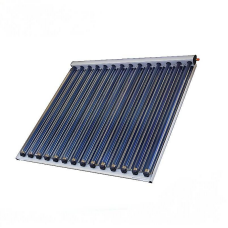
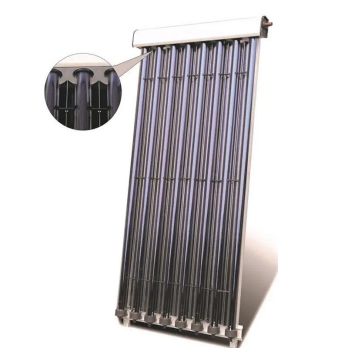
When process water must reach 80–150 °C, the evacuated tube family performs better. Each tube surrounds a metal absorber with a vacuum annulus that nearly eliminates convective loss. The heat pipe version transfers energy through a sealed fluid that vaporizes at the fin and condenses in the manifold, tolerating freeze. The U-pipe version runs pressurized fluid directly through the tube, suiting larger loops. A CPC collector adds a compound parabolic reflector that concentrates diffuse light onto the tube without moving parts.
High-Temperature Needs — Parabolic Trough for Steam and PVT
Industrial users needing process steam above 150 °C turn to the parabolic trough. The DM-PTC-2550 model uses a 2.55 m aperture and heats thermal oil or water to 150–400 °C, feeding process heat loops for dyeing, drying or cleaning. The PVT unit couples a photovoltaic layer with a thermal absorber, yielding electricity and hot water from one footprint. Choosing a solar collector for steam thus means weighing optics against available roof area.
A Real B2B Scenario — Mismatched Heat, Then the Right Fix
Experience shows how temperature mismatch burns budget. A mid-size dairy in a temperate region needed water at 95 °C for cleaning vats. The plant first installed flat plate units sized for comfort heating. Through winter the outlet fell to 55 °C, forcing constant gas-booster use. An engineering review recommended a solar collector upgrade to evacuated tube heat-pipe units matched to 95 °C. After retrofit, the gas booster ran only during peak demand, and the dairy cut steam-fuel use by roughly a third in a heating season. The lesson: specify the temperature first, then the device.
How Collectors Reach Their Temperature
Understanding the physics prevents over-specification. A flat plate collector gains heat from a broad surface but sheds it through the glass as temperature rises, so its ceiling is low. An evacuated tube wins at higher grades because the vacuum stops convection; the selective coating keeps absorption high while emission stays low. In a parabolic trough, a single axis focuses the beam onto a receiver, and thermal oil carries energy to a steam generator without boiling in the field. Each step trades cost and simplicity for the headroom of the chosen solar collector.
Selective Coating and Absorber Plate — Capturing Low-Grade Heat
The absorber plate does the first job: convert incoming radiation to heat. Its selective coating absorbs most of the solar spectrum yet emits little infrared, so collected energy is not immediately radiated back. In low-temperature service this gap matters less, but as target temperature climbs a poor coating wastes the heat a buyer pays to capture. Coating quality therefore tracks directly with the temperature band a unit is rated for.
Vacuum Annulus and Heat-Pipe Extraction in Evacuated Tubes
Inside an evacuated tube, the absorber sits in a near-perfect vacuum between two borosilicate glass walls. With air removed, convection and conduction losses collapse, letting the surface exceed 150 °C. The heat pipe then moves that energy to the manifold without pressurizing the glass: working fluid boils at the hot fin, travels as vapor, condenses at the cooler header, and returns by gravity. This sealed loop means one broken tube can be pulled and replaced without draining the whole array.
Standards, Inspection and Maintenance
Buyers protect budget by checking certification and upkeep before purchase. Independent testing confirms rated performance instead of marketing claims.
Why ISO 9806 and EN 12975 Matter for Procurement
International tests give buyers a common language. ISO 9806 defines solar thermal collector testing for thermal performance and durability, while EN 12975 and EN 12976 cover factory-made and custom-built units. Requesting these reports lets a purchaser compare quoted models on measured output rather than rated labels. A certified solar collector therefore carries more than a label — it carries verified data that avoids both undersupply and wasteful oversizing, where most hidden cost lives.
Buy, Inspect, Use and Maintain — Practical Checklist
Specify the target outlet temperature and flow before requesting quotes. Inspect the absorber plate finish and selective coating for uniform dark tone and no scratches; verify vacuum by checking for the mirrored, not white, appearance of each tube. Use glycol in freeze-prone sites and size pumps for the designed loop. Maintain by clearing shading and checking seals each season so a drifting solar collector shows up early. Replace damaged tubes individually rather than the full bank.
Summary
Matching a solar collector to the needed temperature band is the fastest way to control both budget and performance. Flat plate serves comfort and pools, evacuated tubes and CPC handle medium process heat, and parabolic trough or PVT meet steam and dual-output demands. Demax supports each band with tested, certified units, so procurement teams move from target to shortlist.
Frequently Asked Questions
Question
Which Demax collector fits low-temperature comfort loads?
Answer: Flat plate collectors suit comfort heating, domestic hot water and pool warming where outlet temperatures stay below roughly 80 °C. The dark absorber plate under glass heats a fluid that circulates to a storage tank. With no vacuum envelope, the unit mounts simply and resists weather, though it loses output in cold ambient conditions. Specify the target temperature first, then confirm the model.
Question
Why do evacuated tubes outperform flat plates at higher temperatures?
Answer: A vacuum annulus between the glass walls removes air, so convection and conduction losses nearly disappear as the absorber heats. The selective coating absorbs sunlight while emitting little infrared, preserving energy at grades above 100 °C. Heat-pipe or U-pipe extraction moves thermal energy to the manifold without boiling inside the glass. Flat plates shed heat through the cover as temperature climbs, which caps their useful ceiling well below tube-based designs.
Question
How does a parabolic trough reach industrial steam temperatures?
Answer: A single-axis parabolic mirror focuses the direct beam onto a receiver tube, concentrating sunlight far beyond the level a flat surface captures. Thermal oil or water flows through the receiver and leaves at 150–400 °C, then transfers energy to a steam generator for process duty. The DM-PTC-2550 model uses a 2.55 m aperture for this purpose. Such concentration is necessary when a process demands steam rather than warm water.
Question
Can PVT supply both electricity and hot water at once?
Answer: Yes. A PVT unit layers a photovoltaic cell over a thermal absorber, so the same footprint produces direct current and heats a fluid simultaneously. The electricity offsets pumping or building loads while the recovered heat feeds domestic or process water. This dual output suits sites where roof area is limited and both services are needed. Output shares the device, so neither stream reaches the level of a dedicated single-purpose unit.
Question
Where should buyers verify collector performance before purchase?
Answer: Request independent test reports rather than rely on rated labels. A credible solar collector submission includes ISO 9806 thermal and durability results plus EN 12975 or EN 12976 certification where applicable. Compare quoted models on measured output per square meter of aperture under defined conditions. Verified data prevents both undersized supply and wasteful oversizing, the two mistakes that inflate lifetime cost. Document the reports so later maintenance can reference the original baseline.